Thursday, December 19, 2013

A Complete History of the Life and Times of Santa Claus Backed By Incontrovertible Evidence For His Existence


Santa Claus. A name recognisable to millions of people around the world. A name that instils warm feelings – and presents – to the hearts of children everywhere. A name synonymous with the giving of gifts, the warm sentiments of Christmas, and flying reindeer. Under normal circumstances, I would not have to explain such a wondrous man, but the current state of affairs calls for such redundancy.

For you see, every year, statistics are showing an ever growing number human beings who, against all pretence of logic and rational thought, do not believe in Santa Claus. That is to say, these people do not think such a saint of a man, who devotes his entire life to the appeal of children, exists in any capacity. For those of you who have not ceased reading this in utter disgust at such a disturbing revelation, I shall explain as to the exact nature of my writing. I wish to exterminate the non-belief of Santa Claus, and to do that, I shall provide a complete history of his life, and put forth undeniable evidence for it.

Santa Nicholas Claus was born in the Lebanese town of Tabarja-Adma-Dafne-Kfaryassine in 1458. Born to a large family of fifty-six, Claus had a rough and deprived childhood. With so many children to tend to, his parents often neglected Claus, leaving him to occupy most of his time playing with rocks and evading Islamic crusades.
Despite his parents’ efforts, the lack of medical innovation at the time meant that all of Santa’s brothers and sisters died before they reached the age of twenty, leaving him as an only child. Many would conclude that Claus finally got the attention he deserved as a result of this, but his parents, and his father’s fourteen other wives, died by astonishing coincidence at exactly the same time by completely differing means. To make matters worse for young Santa Claus, his house fell down and all of his possessions caught fire shortly afterward.

With nowhere else to go and nothing else to do, Santa began to wander the desert for the next fifty years, surviving by eating rocks and drinking the blood of his enemies. One day, in 1525, Santa was feeling particularly bored and decided to draw the prophet Muhammad to pass the time. Outraged by this breach of Muslim practices, Muhammad appeared to Santa, while coincidentally looking exactly as depicted in the drawing. Muhammad decided to punish Santa, and cursed him with immortality before disappearing in a puff of Islam.
Now with even less to do and all of eternity to do it, Santa vowed to bring joy to children around the world and not let them experience the miserable childhood he had. He decided to do this on the Christian holiday of Christmas because Muhammad had given him such a raw deal.

Santa began to travel across Europe and gather everything he needed to make his dream a reality. While he was initially unsure of where he would base his operations, he had much time to think while buried alive for two-hundred years after a bar fight in Switzerland. Santa used this solitude to decide on the North Pole as his base of operations, and had his entire present-making facility mapped out in intricate detail within his head by the time he was unearthed by Ludwig van Beethoven for some reason.

Before departing to the North Pole, Santa needed a workforce to work the factories and construct his facility. Luckily for him, Santa discovered a French farmer who had stumbled upon a crashed alien space ship filled with hundreds of extra-terrestrial midgets. Santa purchased these aliens for slave labour, and used their fabulous technology to biologically engineer several reindeer and make then aerodynamically capable. 
Santa came to know his alien slaves as “elves”, which is in actuality a racist term on their planet that Santa deliberately uses to demotivate them. The real name for their species is “Kevin”, not that it matters now. 

Flying to the North Pole on his new alien-enhanced reindeer, Santa and his elves began construction of their immense present production and wrapping facility using grant money from Thomas Jefferson. By 1842, Santa Claus and his elves were ready to begin their first global gift-giving at Christmas. In order to carry millions of presents on a single, reindeer-towed sleigh, the elves’ advanced technology was again implemented, making Santa’s bag dimensionally transcendal; which is to say, bigger on the inside than it is on the outside. In addition, a wizard redundantly cast a spell to assist this process, so that a lazy supernatural explanation could be given to people who don’t understand science.

On the night of December 24th, 1842, Santa’s centuries-old dream of bringing joy to children became a reality, and people’s reception to the forceful intrusion of their homes proved highly positive. For every Christmas thereafter, Santa continued to give gifts to children across the planet right through the 19th and 20th Centuries, and evolved into a powerful and highly influential world figure. It was for these reasons that Adolf Hitler launched an attack on the North Pole in 1940, aiming to destroy such a powerful figure. Santa and his elves fought valiantly, and German army was forced to retreat after heavy casualties. Santa held a violent grudge towards Hitler after this incident, and the Fuhrer’s death in April 1945 was not a suicide as widely believed, but rather the result of Santa breaking into his bunker and killing the bastard himself.

Today, in the 21st Century, Santa’s quest to spread happiness to children remains a pleasant reality, and Santa continues to deliver presents to every country on Earth (with the sole exception of the Democratic People’s Republic of Korea, who actively attempt to shoot down the white-bearded giver of gifts). As it stands, Santa’s production facility spreads over fifteen square kilometres, extending one a half kilometres under the ice and over four kilometres high. The facility currently holds the record for producing the most CO2 emissions within a single mile, and the record for being the largest thing ever built. Twice.

In conclusion, some may ask me how I know all of this, immense historical records notwithstanding. There remains one very simple reason for this; one incontrovertible piece of evidence that will put to rest any molecular inkling of a shred of a doubt that may linger in the minds of any human being who finds themselves reading this: my mom and dad told me when I was a kid, and one time I swear I heard footsteps on the roof.
I rest my case.

Thursday, August 8, 2013

The Problem of Ask.fm (or Rather, What People Think is the Problem)


Just imagine for a moment that you are an inventor, and that you have developed a fabulous device that allows people to play games and enjoy themselves in a variety of fun and inventive ways. Your invention has proven to be a huge success, and millions upon millions of people around the world now use and enjoy the product on a daily basis. One day however, it is discovered that a man has murdered another man by bludgeoning him to death with one of your inventions. Everyone of course is outraged and upset by this news, and are determined to punish the person responsible for this terrible act. The person responsible, they declare, is you, the inventor. How dare you create a product that has so easily facilitated the death of another human being! The next thing you know, your entire business has been shut down and you may be facing criminal charges for your negligence. To any sane and moral being, this is madness and a completely wrong thing to do. To most opponents of Ask.fm however, this would be completely okay.

As I'm sure anyone with even an inkling of what current affairs even are now knows, a subject that has seen major attention in the last few months has been a number of teenage suicides as a result of anonymous abuse on the website Ask.fm. Like an agitated flock of geese, the issue has been a flying frenzy of noise and hysteria, nesting in every news outlet you can shake a wholewheat, goose-nibbled roll of half-assed simile at.
For the few who are not aware, Ask.fm is a social networking site in which users can ask or be asked questions about themselves and display their answers on their profile page. Users do not have to answer every question, and can choose if they want to be anonymous or not, or even if they want to see anonymous questions at all.

Following the suicide of fifteen year-old Ciara Pugsley as a result of being bullied on Ask.fm last year, another case has arisen within the last few days, being the suicide of fourteen-year old Hannah Smith. In each case, a teenage girl was subjected to particularly cruel bullying by anonymous users on Ask.fm and subsequently committed suicide. There have been three others, but as these have been the most high-profile cases, I shall focus on them. Media outlets have jumped on the issue by denouncing Ask.fm in droves and demanding that the site be shut down, with countless members of the public following suit. Most of these vitriolic, knee-jerk reactions are of course being propagated by tabloid publications such as the Daily Mail and the Daily Mirror, but today David Cameron announced that he too shared these sentiments and encouraged people to boycott Ask.fm. Such is the prevalence of this attitude, that most seem content to actually lay the blame of these girls' suicides on the owners of Ask.fm themselves. Such ludicrous opinions range from "they should be ashamed" to the nonsensical heights of "they killed these girls".

As is always the case with sensationalist tabloid campaigns, there is a fundamental lack of common sense, human decency and perhaps most importantly, facts. Of course it is true that these girls committed suicide as a result of bullying on Ask.fm, no one is denying that, nor is the tragedy of these events in question in any respect. What is true is that Ask.fm hosts over 65 million users worldwide, and that the vast majority of its users use the site for nothing more than fun, social interaction. The number of suicides attributed anonymous bullying on Ask.fm is 5. To put this into perspective, the United Kingdom has a comparative population of 63 million. In 2011, some 6,045 people committed suicide in the United Kingdom. That is 1,209 times higher than the suicides attributed to Ask.fm. I am in no way attempting to downplay the seriousness of the 5 suicides in question, but to attribute their causes to Ask.fm itself is a ludicrous leap of logic. The problem here is not online anonymity in itself, the problem is bullying, online anonymity being one of many outlets for the perpetrators. There have been plenty of people who have committed suicide over bullying on Facebook (like nineteen year-old Andrew Cain), but nobody seems to give two shits about that, probably because everyone is on Facebook and wouldn't want such a convenience removed from them.

There are those who then say that while the owners of Ask.fm should not be personally held accountable, they are to blame for refusing to introduce more robust security features and reforms to prevent future cyber-bullying despite the appeals of the people. This is not true either, as basic knowledge of the workings of the site will tell you that there is ‘in-question’ reporting function, which has been in place since 2012, that allows users to report objectionable questions, a 24-hour team of human moderators whose job it is to respond and act upon reported objectionable content, the fact that IP addresses can be used to determine a user's indentity, and most basically, users can choose whether or not to allow anonymous questions to even be seen. All of this and more is spelled out very clearly by Mark and Ilja Terebin, co-founders of the site in an open letter addressing the issue (ironically, the Daily Mirror was the only site to display the full letter without cherry-picking), and the company is currently assisting police in the investigation of Hannah Smith's suicide. From all of this, it can be seen that the accusation that Ask.fm is doing nothing to rectify the issue is also objectively baseless and incorrect.

Fundamentally, Ask.fm was created as creative social website for people to quiz one another anonymously if they so pleased, and of the millions of people who frequent the site, a very small fraction of them have very unfortunately decided to abuse the system provided for them in order to harm others. These people were bullies to begin with, let us not forget that. Mere access to Ask.fm did not spontaneously transform an innocent group of young people into seething fountains of hate and vitriol. Bullying is an age-old problem, and one that has roots in the very foundations of our society, in our social expectations, our judgement of others, our apathy, and not to mention how each individual child is raised by their individual surroundings. It is a complex issue with no simple solution, and scapegoating the creators of one particular website in which such a far-reaching issue has occurred is a pointless and time-wasting endeavour.

I implore people to focus their time and effort not on the false, cover-all solutions that the uncaring and manipulative media propagates, but on discovering and understanding the roots of bullying itself and working together towards solutions that will eradicate the terrorizing of vulnerable people as much as is possible. Don't let those small few limit our freedom of speech, let us instead pinpoint the real offenders and make things better for those who wish no harm.

Thursday, March 21, 2013

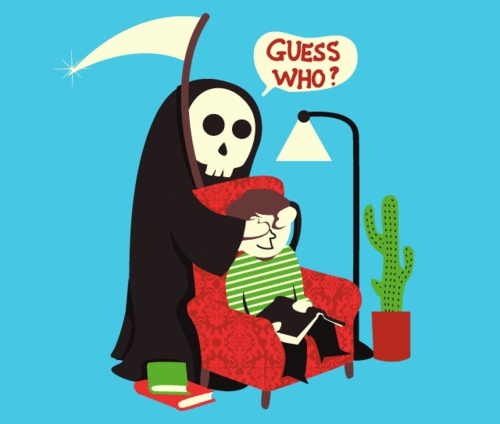
Mortality (or: How I Learned to Stop Worrying and Love Death)


"We are going to die, and that makes us the lucky ones. Most people are never going to die because they are never going to be born. The potential people who could have been here in my place but who will in fact never see the light of day outnumber the sand grains of Arabia. Certainly those unborn ghosts include greater poets than Keats, scientists greater than Newton. We know this because the set of possible people allowed by our DNA so massively exceeds the set of actual people. In the teeth of these stupefying odds it is you and I, in our ordinariness, that are here."
-Richard Dawkins


Perhaps the first matter of priority is one of clarification; the title you see before you is something of a misnomer. I most certainly assure you, my faithful collective audience of about half a dozen, that I am not in a state of mind in which I find it necessary to love death (indeed my feelings on the subject are somewhat to the contrary). I merely wished to reference the 1964 film Dr. Strangelove or: How I Learned to Stop Worrying and Love the Bomb as accurately as was feasible for the subject at hand. Perhaps such a skillful, kidney-rupturingly hilarious cultural allusion will encourage both readers and author alike to actually take the time from their hysterically occupied states of living and view what I am told is a marvelous work of satire.


Casting aside my clumsily executed attempts at linguistic proficiency, I instead would like to discuss a subject far more relevant today than the fear of nuclear annihilation (although North Korea are slowly reviving the popularity of this particular trend). Indeed, the subject I wish to discuss, that of mortality and the nature of death, is one that will never cease to be relevant so long as life continues its current period of success. Unlike my previous deprecatory duo of posts, or "rants" as was so elegantly put by one acquaintance of mine, this particular article will behave more as an exploration of my particular thoughts on the abstract intricacies of mortality.

As I and many others may have asserted in the past, we are all going to die. It's quite a sobering thought, one that every one of us will at some point contemplate, likely with a combination of fear, sadness and hopefully a newfound sense of perspective and self-worth. After all, what is life without death? We live to die, depressingly enough. Mortality is the motivator of all life that has ever lived, is living or has yet to live, simply and slightly poetically put. If beings were granted eternal and indefinite existence, it would appear of the utmost likelihood that life would be forever engaged in a period of idle procrastination. It is death, looming over the flourishing plains of life like a murky storm cloud with all its finality, conclusiveness and the pure unpredictability of its arrival that snaps the living into the focus of achievement and motivation in the broadest of terms. And unlike a storm, death most certainly does not clear with a careful degree of patience.

It would perhaps be preferable to clarify my own understanding of the process of death in order for these points to become more clear. I do not believe in any form of afterlife, whether it be Heaven, Hell, Purgatory, Asgard, Valhalla, the Underworld, the process of reincarnation or becoming one with the Force. There is not, nor has there ever been, any evidence for the existence of an "after", and most certainly not any of the ludicrously defined post-death extravaganzas invented by close to every religion that has ever been formulated. All evidence gathered by scientific observation has shown that when the brain shuts down upon death, with it goes consciousness, personality, memory and those trivial little facts you like to impress people with at dinner parties. Total cessation of existence, to pull a blanket term over the blunt pattering of descriptive vocabulary. It is as a result of the evidence for the latter and lack thereof for the former that I do not find myself capable of believing in a life after death.

Do not mistake my words as being those of unmovable staunchness, however. It's quite untrue to say that I refuse the possibility of any state of existence that may follow death; if evidence to suggest such an idea were to present itself I would be sure to consider it more openly. Nor for that matter do I particularly welcome the idea of the annihilation of my consciousness, but my acknowledgement of reality reigns supreme over any discomforts I may possess. In the meantime however, it fascinates me to speculate as to ways one can relate to the feeling (or rather the non-feeling) of death, of being totally and completely unconscious. Indeed, such a seemingly unfathomable state is not quite as seemingly unfathomable as it may seemingly seem.

If one is familiar with the basic procedures of say, open heart surgery, one will find themselves familiar with the use of anesthetic gas, used to force a patient into unconsciousness so that they may not feel the undoubtedly painful experience of a surgeon plunging medical instruments into their open chest cavity. Despite the often used term of being "put to sleep" (a misnomer much like the title of this very post), anesthetic gas does not induce sleep at all, but instead total, dreamless unconsciousness. Supposed dreams under effects of anesthetics actually occur in the slow waking period, hours after surgery. The reason I exposit this medical trivia is to make the point that mentally, people under anesthetic influence are for all intents and purposes, dead.

They cannot think, they cannot feel, they cannot see nor can they hear. They as a person do not exist for the period in which they are unconscious. The same can be said for a particularly dreamless sleep; the variety that gives the impression that one has only just lain their head upon the warmth of their pillow before instantly waking to a pillow of damp reluctance. Death as I understand it is not as alien to the human mind as would initially seem to be the case. For all the cliché of the phrase, it really is just like going to sleep. And thus is the reason why death should not be feared.

With a naturalistic view of death such as my own, I often find even myself pressing the question "shouldn't I be afraid of this?" While for the most part I find myself unfeeling towards the inevitable demise that awaits me, flashes of fear do occasionally illuminate my indifference. Upon closer analysis however, I conclude that I fear not being alive as opposed to being dead. To know that my life will some day be cut short and I will no longer have the opportunity to experience the marvelous universe we inhabit - that is what frightens me, not being dead. In his final, cancerous months, enlightening essayist and revolutionary intellectual Christopher Hitchens had this to say; “Do I fear death? No, I am not afraid of being dead because there's nothing to be afraid of, I won't know it. I fear dying, of dying I feel a sense of waste about it and I fear a sordid death, where I am incapacitated or imbecilic at the end which isn't something to be afraid of, it's something to be terrified of.

Life is nothing without death. Some may find this depressing, but the same some should also remember this - death is nothing without life. Death is nothing, for that matter. It is not to be feared, but to be accepted, even embraced. Because it is death that grants the will to live. The will to live driven by the knowledge that one day it shall be taken from us. And that there will be no second chances.

Thursday, March 7, 2013

The Dangers (And Stupidity) Of Collective Identity


I return, ladies, gentlemen and variations thereupon, to present your ambiguously aligned selves with another blog post fresh from the worryingly eager tips of my upper appendages. I hope you'll forgive me for making much of that sentence entirely superfluous, but I have not committed to writing in some time and felt the need to begin as literately as I could muster. Indeed, I have found myself rather busy, a fact which lends itself to the subject of this very post.

I recently found myself visiting Belfast on a school trip, primarily a historically educational excursion that I recommend to any who find themselves with the unlikely opportunity to experience the same event exactly as it has already happened. A more preferable and physically possible option is to simply visit Belfast of one's own accord, but I digress. As enjoyable as the trip was, seeing the horribly deprived working-class areas of the city, each segregated by religion and political opinion, reawakened a thought I've harboured for some time. Collective identity is one of the main detriments to our entire species.

"What is collective identity?" I pretend you ask. To be as basic as I can, collective identity is the process of identifying large numbers of people based upon certain similarities shared between those people. To quote Wikipedia (where would we be without it?), a broad definition of the term collective identity is "the shared sense of “we-ness.” Collective identity is conceptualized as individuals’ identifications of, identifications with, or attachment to certain groups". For example, referring to all Protestants as a collective whole, or all those who have a certain political opinion or all people who enjoy eating sugar-encrusted cucumber. It's not quite stereotyping, although the two are often intertwined. It's not about labeling these collective wholes with stereotypes, it is the act of treating all those who have ever been in the group as equally responsible for what it does.

The most common form of collective identity by far is that of countries. How many times has one heard one speak of Germany or America or China as though it were a single person responsible for every action they have ever performed? These countries have each existed for a very long time, their governments have changed repeatedly and generations have lived and died in these countries countless times. And yet we continue to speak of countries as though they have remained forever inhabited by the same individuals. Let me be more specific; let me address one of the worst and most well known examples of collective identification: the conflict between Ireland and the United Kingdom.

Irish society is and always has been built upon hatred of Britain. Our culture glorifies some of the most reprehensible figures in Irish history simply because they opposed Britain. The reasoning behind so much of distrust and contempt towards Britain is always justified by something to the effect of "the British killed my grandfather!" or "The British oppressed us for 800 years!" Even the more moderate Irish who oppose minor incidences, such as David Norris' suggestion to rejoin the United Kingdom, do so on the same basis. For anyone who shares these views even slightly, ask yourselves: who exactly are you angry with? Say a British soldier killed a distant relative of yours. It's very true that many British soldiers killed many Irish people. What is also true is that those soldiers are dead. Oliver Cromwell and all those who committed genocide under his command have been dead for hundreds of years. How can one possible make a logical connection between the atrocities of individuals long dead and the entirety of the United Kingdom? Furthermore, it's not as if every single person in Britain contributed to the murder of Irish citizens even at the time of the actual atrocities. The vast majority had nothing to do with it, and the people of Britain today sure as hell don't either.

The point I'm trying to make here is that guilt is not hereditary, nor is it shared with those who happen to live in the same place, or those who have the same religion. I merely use the United Kingdom as a single example, because there are so many more. Israel versus Palestine, India versus Pakistan, the United States versus all those other countries the US government has attacked in the past, one can go on indefinitely. They all justify their ongoing conflicts and discriminatory dispositions with the sins of those either long dead or irrelevant. The entire practice is bathed in ignorance and stupidity and even the most logical and intelligent among us fall victim to such collective identification. If one really wishes to bring justice to those responsible for atrocities, then punish those who are actually responsible. It is an unfortunate reality that many propagators of injustice have died without due punishment. This is unfortunate, but there is nothing that can be done to rectify it. Do not lay the blame upon their ancestors, for they are separate beings and always will be.

This too works in the other direction. A good deed is not passed by blood, nor is its ownership shared by those around it. Judge people as individuals and not as the similarities they have with with others. Believe me when I say that if everyone thought as logically as this, war would pretty much cease to exist.

But then that would be too easy, wouldn't it?

Friday, February 15, 2013

The Universe Doesn't Care About You and That's Okay

This, ladies, gentlemen and variations thereupon, is a blog. Brilliant, the first sentence is always the hardest, glad to get that out of the way. Furthermore, the first blog post is always the most difficult, particularly when one has created the blog impulsively and with little thought as to what the actual subject matter will be. Nonetheless, I've settled on taking some time to talk about life, the universe, and everything. I'm ambitious like that.

It's come to my attention over the course of my life, and indeed of humanity's short existence, that we inhabit a universe of inconceivable scale. Our universe is ancient and young, creative and destructive, dishearteningly empty and majestically inhabited all at the same time and never staying the same for a single millisecond. The unstoppable wonder that is the scientific method has deduced that our universe is somewhere in the region of 13.7 billion years old. The human species is just under 200,000 years old. Think about that for a moment. Really try to grasp how small you and I and everyone else really is. We are a speck; a single drop of water in all the waters on Earth, a single grain of sand in all the beaches in all the world, a single explosion in a Michael Bay popcorn flick. We are, all of us, really very small and insignificant.

Our species' collective refusal to accept this is indeed a part of our inherent arrogance. For as long as man has learned to walk on his own two feet, he has exploited his fellow primate for his own benefit. Religions and governments have all existed in one way or another to feed the egos of those willing to forego their in-built empathetic sensibilities. Even to this day, the short-sighted elite, the corporations and the governments; they squander the only home we have to satisfy their self-indulgent apathy. This unquenchable greed has extended to the lower levels of society and infected the collective societal consciousness as well. All people seem interested in is securing a comfortable existence for themselves - wasting and consuming whatever comes their way as long as it satisfies the inhabitants of their tiny little bubble. To be rather blunt, today's society does not give the slightest inclination of a fuck about the bigger picture. Hey, as long as we're content, who gives a shit about everything else?

Here I'd like to go back to belittling you and the people you love, because frankly we are all in need of some perspective. This is you: a single human out of seven billion humans. Along with all the other humans, you live in one tiny corner of a single planet that orbits one star out of 100 billion stars in this one single galaxy. And this galaxy is still nothing, because there are hundreds of billions of galaxies in every single direction around it. After really thinking about this, do you actually think you still have any weight in all of this? You are unimaginably tiny and the sooner you realise this, the better off we all will be.

As you may or may not have gathered from those previous few paragraphs, I've been rather cynical about this whole affair. Another thing that you may or may not have noticed is that this post is entitled "The Universe Doesn't Care About You and That's Okay", which would suggest some sort of uplifting reassurance with regards to my scathing critique of our species. I assure you, dear reader, that reassurance is  most certainly assured. It is indeed okay that the universe does not care about you because when one truly and genuinely realises this, one is amazed at how much humility this revelation bestows upon an individual.

To think that a person can learn to see their priorities not in their own comfort, but in the comfort and stability of others is a fact I find genuinely wonderful. If one can imagine a world in which human cooperation and  advancement far outweighs the murky waters of consumerism and self-preservation and prejudices and apathy, one must only take the first step and get some perspective. Not to bombard you with new age hippie philosophy, but John Lennon had a point. The universe and existence at large may behave with the utmost indifference towards you, life itself might not care in the slightest, but your friends and your family and your loved ones are quite the opposite. Take comfort in those you love and learn to think of the bigger picture.

As the late, wise and marvellously enlightening Carl Sagan once said, "we are the universe experiencing itself." As I said, the universe is mind-bogglingly vast, inhabited only by the most beautiful of sights, the most impossible of concepts, the most endless of knowledge to absorb and the most wonderful motivations for living to ever be. So go out there and experience it. Enjoy the little things and the big things and the things that you might never get the chance to enjoy again. You have this one and only life to make it count, and our indifferent universe could end it at any moment. You never know, you might even have fun.

Okay, that was a blog post. That's new.