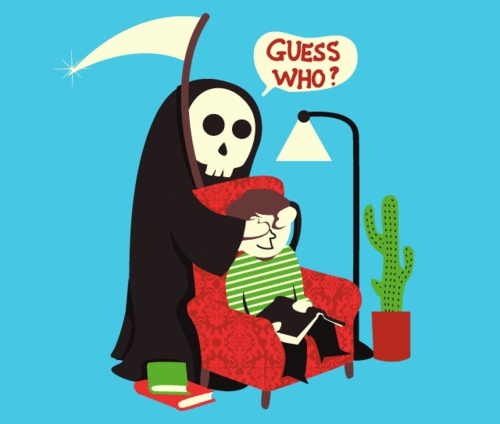
"We are going to die, and that makes us the lucky ones. Most people are never going to die because they are never going to be born. The potential people who could have been here in my place but who will in fact never see the light of day outnumber the sand grains of Arabia. Certainly those unborn ghosts include greater poets than Keats, scientists greater than Newton. We know this because the set of possible people allowed by our DNA so massively exceeds the set of actual people. In the teeth of these stupefying odds it is you and I, in our ordinariness, that are here."
-Richard Dawkins
Perhaps the first matter of priority is one of clarification; the title you see before you is something of a misnomer. I most certainly assure you, my faithful collective audience of about half a dozen, that I am not in a state of mind in which I find it necessary to love death (indeed my feelings on the subject are somewhat to the contrary). I merely wished to reference the 1964 film Dr. Strangelove or: How I Learned to Stop Worrying and Love the Bomb as accurately as was feasible for the subject at hand. Perhaps such a skillful, kidney-rupturingly hilarious cultural allusion will encourage both readers and author alike to actually take the time from their hysterically occupied states of living and view what I am told is a marvelous work of satire.
Casting aside my clumsily executed attempts at linguistic proficiency, I instead would like to discuss a subject far more relevant today than the fear of nuclear annihilation (although North Korea are slowly reviving the popularity of this particular trend). Indeed, the subject I wish to discuss, that of mortality and the nature of death, is one that will never cease to be relevant so long as life continues its current period of success. Unlike my previous deprecatory duo of posts, or "rants" as was so elegantly put by one acquaintance of mine, this particular article will behave more as an exploration of my particular thoughts on the abstract intricacies of mortality.
As I and many others may have asserted in the past, we are all going to die. It's quite a sobering thought, one that every one of us will at some point contemplate, likely with a combination of fear, sadness and hopefully a newfound sense of perspective and self-worth. After all, what is life without death? We live to die, depressingly enough. Mortality is the motivator of all life that has ever lived, is living or has yet to live, simply and slightly poetically put. If beings were granted eternal and indefinite existence, it would appear of the utmost likelihood that life would be forever engaged in a period of idle procrastination. It is death, looming over the flourishing plains of life like a murky storm cloud with all its finality, conclusiveness and the pure unpredictability of its arrival that snaps the living into the focus of achievement and motivation in the broadest of terms. And unlike a storm, death most certainly does not clear with a careful degree of patience.
It would perhaps be preferable to clarify my own understanding of the process of death in order for these points to become more clear. I do not believe in any form of afterlife, whether it be Heaven, Hell, Purgatory, Asgard, Valhalla, the Underworld, the process of reincarnation or becoming one with the Force. There is not, nor has there ever been, any evidence for the existence of an "after", and most certainly not any of the ludicrously defined post-death extravaganzas invented by close to every religion that has ever been formulated. All evidence gathered by scientific observation has shown that when the brain shuts down upon death, with it goes consciousness, personality, memory and those trivial little facts you like to impress people with at dinner parties. Total cessation of existence, to pull a blanket term over the blunt pattering of descriptive vocabulary. It is as a result of the evidence for the latter and lack thereof for the former that I do not find myself capable of believing in a life after death.
Do not mistake my words as being those of unmovable staunchness, however. It's quite untrue to say that I refuse the possibility of any state of existence that may follow death; if evidence to suggest such an idea were to present itself I would be sure to consider it more openly. Nor for that matter do I particularly welcome the idea of the annihilation of my consciousness, but my acknowledgement of reality reigns supreme over any discomforts I may possess. In the meantime however, it fascinates me to speculate as to ways one can relate to the feeling (or rather the non-feeling) of death, of being totally and completely unconscious. Indeed, such a seemingly unfathomable state is not quite as seemingly unfathomable as it may seemingly seem.
If one is familiar with the basic procedures of say, open heart surgery, one will find themselves familiar with the use of anesthetic gas, used to force a patient into unconsciousness so that they may not feel the undoubtedly painful experience of a surgeon plunging medical instruments into their open chest cavity. Despite the often used term of being "put to sleep" (a misnomer much like the title of this very post), anesthetic gas does not induce sleep at all, but instead total, dreamless unconsciousness. Supposed dreams under effects of anesthetics actually occur in the slow waking period, hours after surgery. The reason I exposit this medical trivia is to make the point that mentally, people under anesthetic influence are for all intents and purposes, dead.
They cannot think, they cannot feel, they cannot see nor can they hear. They as a person do not exist for the period in which they are unconscious. The same can be said for a particularly dreamless sleep; the variety that gives the impression that one has only just lain their head upon the warmth of their pillow before instantly waking to a pillow of damp reluctance. Death as I understand it is not as alien to the human mind as would initially seem to be the case. For all the cliché of the phrase, it really is just like going to sleep. And thus is the reason why death should not be feared.
With a naturalistic view of death such as my own, I often find even myself pressing the question "shouldn't I be afraid of this?" While for the most part I find myself unfeeling towards the inevitable demise that awaits me, flashes of fear do occasionally illuminate my indifference. Upon closer analysis however, I conclude that I fear not being alive as opposed to being dead. To know that my life will some day be cut short and I will no longer have the opportunity to experience the marvelous universe we inhabit - that is what frightens me, not being dead. In his final, cancerous months, enlightening essayist and revolutionary intellectual Christopher Hitchens had this to say; “Do I fear death? No, I am not afraid of being dead because there's nothing to be afraid of, I won't know it. I fear dying, of dying I feel a sense of waste about it and I fear a sordid death, where I am incapacitated or imbecilic at the end which isn't something to be afraid of, it's something to be terrified of.”
Life is nothing without death. Some may find this depressing, but the same some should also remember this - death is nothing without life. Death is nothing, for that matter. It is not to be feared, but to be accepted, even embraced. Because it is death that grants the will to live. The will to live driven by the knowledge that one day it shall be taken from us. And that there will be no second chances.

No comments:
Post a Comment